The Infinite Workday Starts in Your Inbox
Microsoft's 2025 data shows workers face 275 interruptions a day. Here's why your inbox is likely the front door to fragmented work—and how to fix it.
Inbox Ninja Team
Inbox Ninja
Most people think the workday gets hijacked by meetings.
They're wrong.
Meetings are visible. Your inbox is not. Email is the hidden layer that starts before breakfast, fractures the middle of the day, and follows people back into bed at night.
Microsoft's 2025 Work Trend data puts hard numbers on what knowledge workers already feel: the average employee receives 117 emails and 153 Teams messages per day, while being interrupted 275 times daily by meetings, email, or chat—roughly once every two minutes during core work hours. On top of that, 40% of people who are online at 6 a.m. are already reviewing email, and by 10 p.m., 29% of active workers are back in their inboxes again.
That is not a normal workday. It's an operating system failure.
| Signal | What Microsoft's 2025 data shows |
|---|---|
| Daily interruptions | 275 pings from meetings, email, or chat |
| Early-morning email | 40% of 6 a.m. active workers are already in email |
| Late-night inbox return | 29% of active workers are back in their inbox by 10 p.m. |
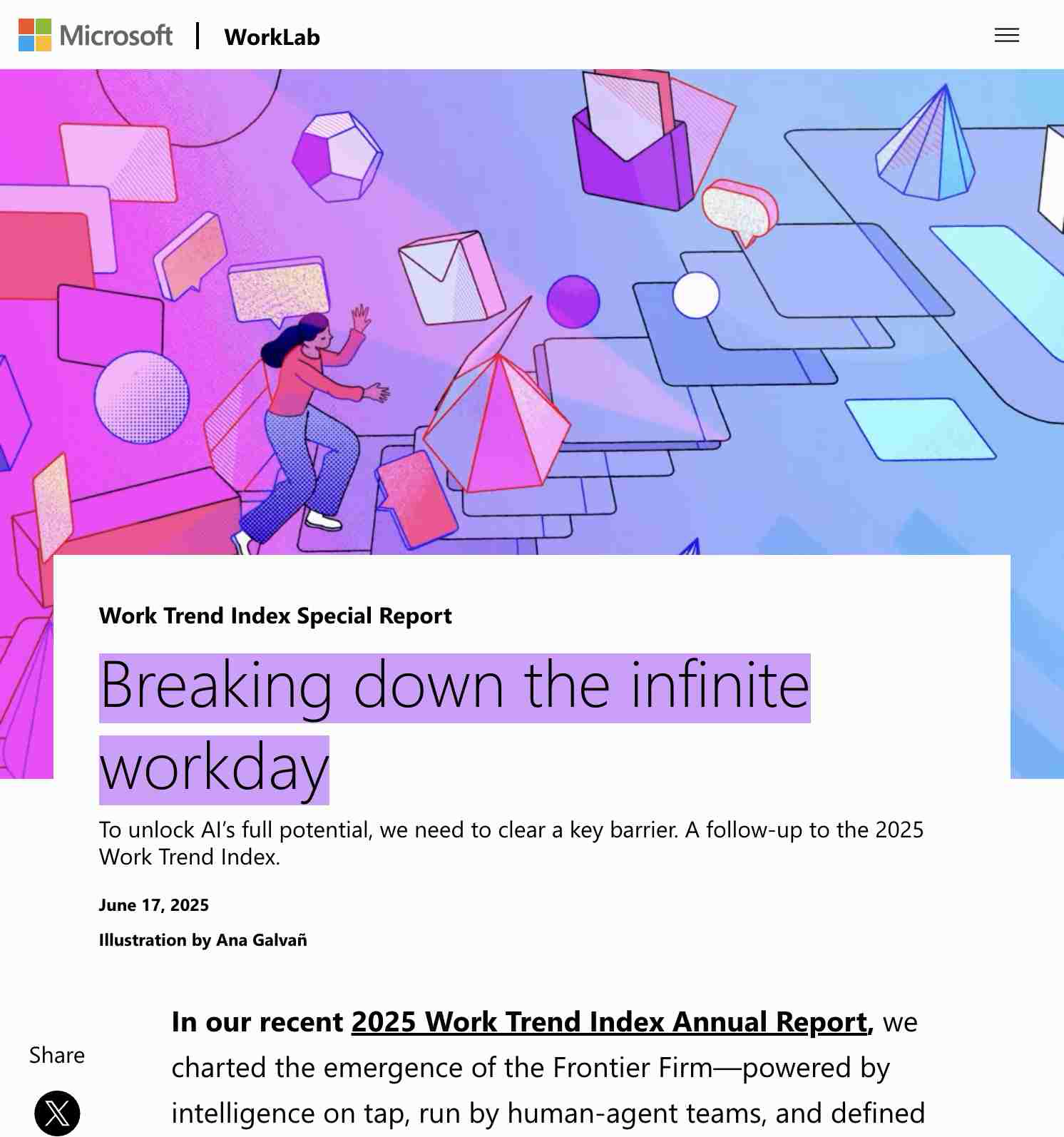
Source: Microsoft WorkLab — Breaking down the infinite workday, captured May 2026.
If your team feels busy all day but still ends the day with the sense that nothing important moved forward, this is probably why.
At a glance: what the infinite workday is doing to teams
- 275 interruptions per day means the average worker gets knocked off task roughly once every two minutes during core hours.
- 153 daily Teams messages plus 117 emails is why inbox advice fails when chat and meetings are treated as separate problems.
- 40% checking email by 6 a.m. and 29% returning by 10 p.m. shows the workday is expanding at both ends, not just in the middle.
The inbox is where the infinite workday begins
The usual story about modern work goes like this: Slack ruined focus, meetings took over calendars, and remote work blurred boundaries.
All true. But email is still the front door.
Microsoft's June 2025 special report, based on trillions of Microsoft 365 productivity signals plus a 31,000-person global survey, found that the workday starts early and starts in email. Before 8 a.m., email dominates. By 6 a.m., a large share of workers are already scanning messages to figure out the day's priorities.
That detail matters because it shows what email has become: not just a communication channel, but a daily triage queue. People are not opening their inbox because they love asynchronous communication. They're opening it because too much work is routed there first.
McKinsey has been warning about this for years. Knowledge workers spend up to 28% of the workweek reading and answering email—more than 11 hours a week in many cases. When your planning system, follow-up system, notification system, and decision log all collapse into the inbox, email stops being a tool and becomes your workplace's default backlog.
117 emails is bad. 117 emails plus everything else is worse.
One reason inbox advice often fails is that it treats email like an isolated problem.
It isn't.
Microsoft's data shows the average worker also receives 153 Teams messages a day. That means the problem isn't just "too much email." It's too many incoming demands across too many channels, all competing to feel urgent.
This is how fragmented work happens.
A message comes in. You skim it. You don't answer yet. Another email arrives. Then a Teams ping. Then a calendar invite. Then an email with 20 people copied because nobody wants to own the decision. By the time you get back to the first thread, you no longer remember what you were doing before any of this started.
Microsoft found that nearly half of employees (48%) and more than half of leaders (52%) say work feels chaotic and fragmented. That shouldn't be surprising. The modern knowledge worker isn't failing at focus because of personal discipline. They're trying to think clearly inside a system designed for interruption.
Most email is triaged, not processed
Here is the bleakest number in the Microsoft report: 85% of emails are read in under 15 seconds.
That is not thoughtful reading. That's survival behavior.
People are not carefully processing email. They are scanning subject lines, checking sender names, making snap judgments, and deferring decisions because the queue behind each message is already too long. The inbox has become a place where work is acknowledged without being resolved.
This creates three predictable problems:
- Important messages get buried because they look too similar to low-value messages.
- Follow-ups multiply because skimmed emails often produce incomplete replies or no reply at all.
- Cognitive load stays high because every unprocessed thread remains mentally open.
That last point matters more than most teams realize. Unfinished email does not stay in your inbox. It stays in your head.
Broadcast culture makes the problem worse
Microsoft also reported that mass emails with 20+ recipients rose 7% year over year.
That's a small number with big implications.
Large-recipient email is usually a sign of organizational ambiguity. People add more recipients when they aren't sure who owns the decision, when they want cover, or when email is being used as a broadcast mechanism instead of a precise communication tool.
The result is predictable: more people receive messages they don't need, more people skim them just in case, and the signal-to-noise ratio of the inbox gets worse.
This is one reason "inbox zero" advice often feels insulting. The problem is rarely just that individuals are disorganized. In many teams, the inbox itself has become structurally noisy.
If you want fewer unread messages, you don't just need better filters. You need fewer unnecessary emails entering the system in the first place.
The workday now has a third shift
The 9-to-5 was already mostly fiction for knowledge work. Microsoft's 2025 data makes that explicit.
- 40% of workers online at 6 a.m. are already in email
- Messages outside the 9-to-5 workday are up 15% year over year
- The average worker now sends or receives 58 chats outside business hours
- 29% of active workers are back in their inbox by 10 p.m.
- Nearly 20% of employees working on weekends are checking email before noon on Saturday and Sunday
Source: Microsoft 2025 Work Trend Index Annual Report.
This matters because the damage isn't just about hours worked. It is about recovery time lost.
If email is the first thing people check in the morning and the last thing they revisit at night, then the inbox is not just interrupting work. It is invading the time that was supposed to restore the capacity to work.
That is how the infinite workday sustains itself. Not through one dramatic emergency, but through dozens of tiny acts of digital vigilance that never fully stop.
Source: Hacker News — search "infinite workday", captured May 2026.
Why this keeps happening
Organizations usually respond to inbox overload with personal productivity tips:
- check email less often
- turn off notifications
- use folders better
- get to inbox zero
Some of that helps. None of it solves the root problem.
The root problem is that email has become a catch-all workflow for things that should have been handled elsewhere.
Status updates become email.
Approvals become email.
Loose tasks become email.
Meeting recaps become email.
"Just keeping you in the loop" becomes email.
When email becomes the fallback system for coordination, the inbox stops reflecting communication volume and starts reflecting organizational design failure.
That's why the inbox feels impossible even for competent people. They're not just managing messages. They're managing broken process through messages.
What teams should do instead
If the problem is systemic, the response has to be systemic too.
Here are the fixes that matter most:
1. Stop using email as a task manager
If a message creates work, convert it into a tracked task quickly. Don't let action items live indefinitely inside inboxes where they depend on memory and repeated re-reading.
2. Reduce broadcast email aggressively
Audit distribution lists. Limit who can send all-hands style updates. Default to smaller recipient lists. If 20 people are copied, there should be a reason.
3. Create response-time norms
Most inbox anxiety comes from unclear expectations. Define what actually requires a same-day response, what can wait 24 hours, and what is purely informational.
4. Separate triage from processing
The goal is not to stare at email all day. The goal is to quickly identify what matters, then handle those items in dedicated blocks instead of continuous partial attention.
5. Use AI for the boring part, not the important part
The highest-value use of AI in email is not writing fake-polished replies to everything. It's reducing noise: summarizing long threads, highlighting what needs action, drafting follow-ups, and helping people distinguish signal from clutter.
That is where tools like Inbox Ninja fit naturally. If workers are reading most messages in under 15 seconds anyway, the advantage is not another prettier inbox. The advantage is faster, more reliable triage—knowing what matters, what can wait, and what should never have reached you at all. The strategic shift is to stop organizing first and start handling first; AI Email Writer Strategy: Draft, Don't Decide explains why that changes the economics of email work.
Related reading
If this pattern sounds familiar, these guides cover the human cost from different angles:
- The Always-On Trap: How After-Hours Email Expectations Are Quietly Burning Out Your Team shows why the expectation of being reachable matters as much as the time spent replying.
- How to Overcome Email Anxiety covers the compulsive checking loop and the tactics that help workers regain control.
- Notification Zero expands the problem beyond email and shows how to batch Slack, Teams, task tools, and inbox review into one calmer operating rhythm.
The real goal is not inbox zero
Inbox zero is a nice feeling. It is not a business strategy. If you want a practical system for getting there anyway, see our inbox zero guide.
The real goal is to make email boring again.
Boring means email is not the place where your day begins in a state of low-grade panic. It is not where work goes to wait. It is not where important decisions disappear into a pile of newsletters, CC storms, and status theater.
Email should be a useful layer of communication, not the system that silently determines whether your team gets real work done.
Right now, for many teams, the inbox is doing far too much. That's why the workday feels endless.
The infinite workday doesn't begin with a calendar invite.
It begins with a morning inbox check that quietly tells your brain: you're already behind.
Sources
- Microsoft WorkLab, Breaking down the infinite workday
- Microsoft WorkLab, 2025: The year the Frontier Firm is born
- Microsoft, 2025 Work Trend Index Annual Report (PDF)
- McKinsey Global Institute, The social economy: Unlocking value and productivity through social technologies
Related Articles
The Always-On Trap: How After-Hours Email Expectations Are Quietly Burning Out Your Team
Research reveals after-hours email expectations cause burnout through anticipatory stress, not time spent. Here's what the science says.
The Best AI Email Writers in 2026, Ranked by What They Actually Draft
Looking for the best AI email writer in 2026? This guide ranks eight tools by the thing buyers actually care about: the draft that shows up on screen, how much you still rewrite, and whether the tool helps clear the surrounding inbox work.
AI Email Assistant for Gmail: What Works in 2026, What Doesn't, and How to Choose One
Gmail has its own AI features. So does every email assistant on the market. Here's what each actually does for your inbox, and how to pick one without wasting a week.
Ready to hit inbox zero?
Inbox Ninja triages your email, summarizes threads, and drafts replies in your voice.
Open Inbox Ninja